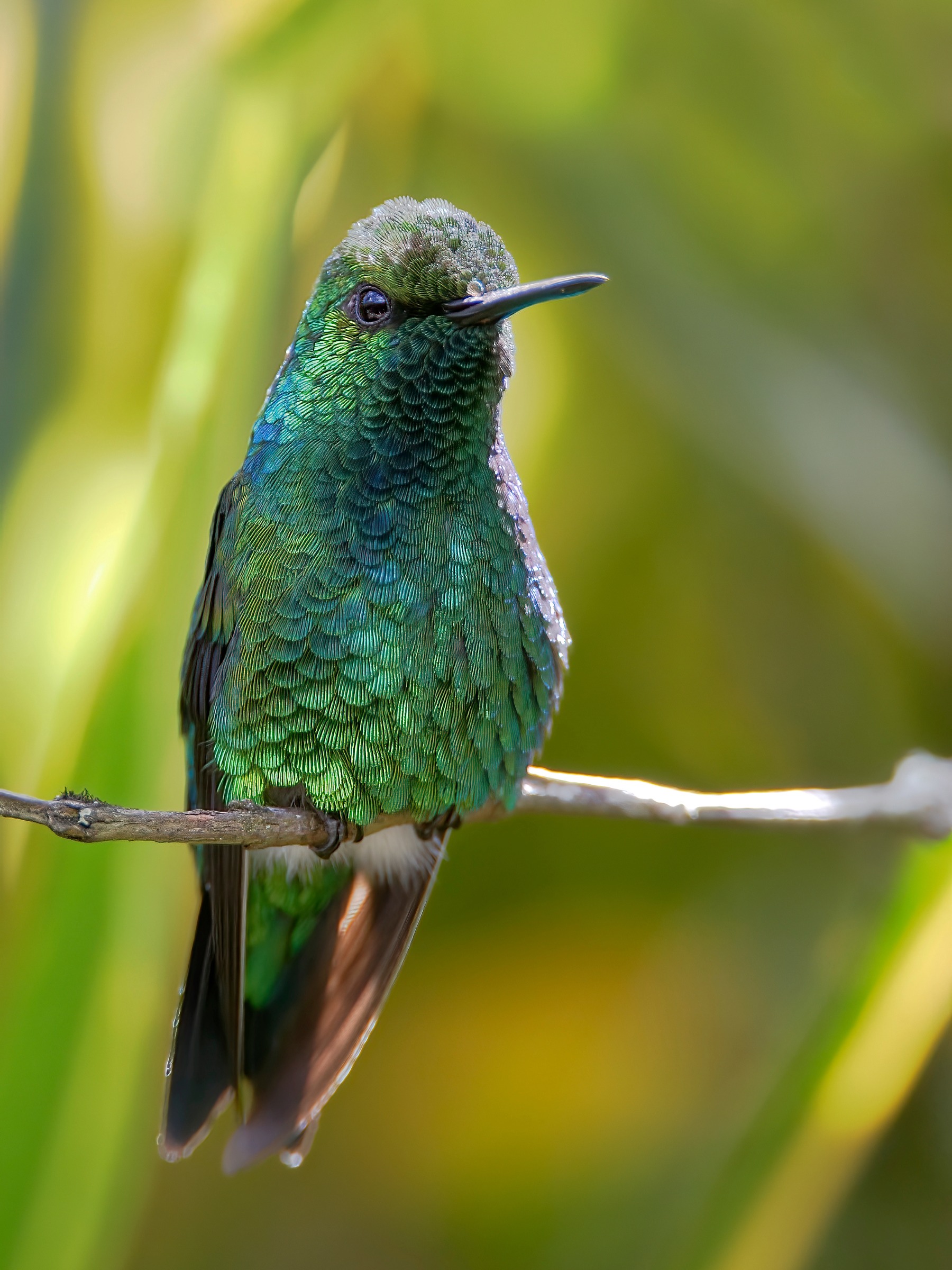
The Western Emerald (Chlorostilbon melanorhynchus) is a small, short-billed hummingbird of western Ecuador and Colombia. The male is emerald green with a dark blue tail; the female has pale gray underparts and a distinct white line behind the eye. It is worth learning the habitat as well as the field marks before adding this bird to a Mindo-area itinerary.
This guide explains what to look for, how it feeds and how to plan a search without assuming that every hummingbird garden holds the same species. Use the photograph alongside the identification reference, then discuss suitable stops if Western Emerald is a priority.
Western Emerald uses relatively open, often dry habitats and forest edges within its western Ecuador and Colombia range. A general Mindo hummingbird outing is not confirmation that this species will be present at a particular stop. Check recent observations and the habitat of any proposed site before building the day around it.
Make the target clear before booking
Send the guide the scientific name as well as the English name, your dates and starting point. Explain whether a dedicated search matters more than seeing a broad selection of hummingbirds. That gives us a useful starting point for discussing a route, travel time and alternatives if current information does not support a focused search.
Western Emerald identification
Male: green body, blue tail
Look for a small hummingbird with shimmering green plumage, a dark blue tail and a short, straight bill. Observe the tail and overall proportions as well as the green body. Iridescent feathers can look much darker when the bird turns away from the light, so a single dark photograph may hide useful detail.
Female: pale underside and facial pattern
The female is green above and pale gray below. A dark cheek contrasts with a white line behind the eye. Try to see a side view that includes the face, bill and underside rather than identifying it from the back alone. A feeding bird may offer only brief views, making several photographs more useful than one.
Look at the whole bird
Start with size, bill shape, tail and facial pattern, then check the location and habitat. A green hummingbird at a feeder is not enough for identification. If you are unsure, keep the record provisional and compare it with the male and female photographs in the Cornell/eBird reference.
Range, elevation and habitat
Western Ecuador and Colombia
Cornell/eBird places the species mainly between 600 and 1,800 metres, with locally higher occurrences in Andean valleys. This is range context, not an elevation band that guarantees a sighting. For trip planning, combine elevation with the type of vegetation and recent records from the actual site.
Open areas and forest edges
Look into suitable gardens, edges and fairly open dry habitat rather than assuming a deep cloud-forest trail is the best starting point. When discussing a reserve or garden, ask which part of the site has relevant habitat, how long a stop allows and whether access is suitable for your group.
Feeding behavior: where to focus your attention
Watch the lower and middle levels
The species is typically observed alone while feeding in gardens or along edges, often at lower or middle levels. Instead of watching only the canopy, scan accessible flowers and nearby perches. Stay in one position long enough to follow a bird between feeding visits without chasing it through the vegetation.
Feeders can help, but do not settle the identification
Western Emerald visits feeders. A feeder view may make the bill, facial pattern or tail easier to examine, but the presence of hummingbirds does not confirm this particular species. At a busy feeding station, follow one individual at a time and make notes before switching attention to another bird.
Western Emerald and similar hummingbirds
Check location as well as appearance
Blue-tailed Emerald is extremely similar in both sexes, but Cornell/eBird reports no overlap in their ranges. A location attached to a photograph therefore matters. For an image without a reliable location, compare the distribution information as well as the visible field marks before assigning a name.
Build a useful identification record
Keep the date, site and original photographs together. A side view, an underside view and a view of the tail can answer different questions; retain imperfect images if they show one of those details. If identification is unresolved, share the sequence with the guide rather than relying only on the most attractive crop.
Photographing a small iridescent hummingbird
Choose a position before the bird arrives
Find an existing viewing space that leaves flowers, feeders and flight paths clear. Check the background and light from that position, then wait. A bird turning on a perch can change from bright green to a dark silhouette, so review exposure and feather detail rather than judging the image only from the brightness of the background.
Prepare for brief views
Bring binoculars even if photography is the main goal. They help you follow the individual between visits and confirm details that are small in the camera frame. Tell the guide whether you want a relaxed observation stop or time for a longer photographic wait; those are different ways to use a limited morning.
Keep the bird’s routine intact
Do not move feeders, handle flowers or clear vegetation for a cleaner photograph. Avoid following a bird each time it changes perch. Follow site rules on flash and equipment, keep a respectful distance and leave space for other visitors. A useful record does not require a close approach.
Plan the outing around your priorities
A broad hummingbird outing
Choose the dedicated hummingbird tour when your main goal is to enjoy several species in a focused three-hour outing. Ask about the proposed stops and current conditions before treating Western Emerald as part of the expected list. The wider hummingbird guide can also help you compare guided and independent visits.
For a target-led day, share the full bird list, available time, photography needs and any walking limitations. Discuss whether the itinerary should stay near Mindo or consider a wider route. If the target cannot be supported by current information, agree another rewarding birding option before confirming transport and timing.
Species identification, range, elevation and feeding context are drawn from the Western Emerald account from eBird / Cornell Lab. Its male and female reference photographs are useful for comparison. Site-specific availability should be checked separately when planning a visit.
Frequently asked questions
What does a male Western Emerald look like?
A male is shimmering emerald green with a dark blue tail and a short, straight bill. Check several views because iridescent plumage changes appearance with the angle of the light.
How can I recognize the female?
Look for green upperparts, pale gray underparts, a dark cheek and a white line behind the eye. A side view showing the face and bill is especially useful.
Does Western Emerald visit feeders?
Yes. Cornell/eBird describes feeder visits, as well as feeding in gardens and along edges. A busy feeder alone does not establish that Western Emerald is present.
Is it the same as Blue-tailed Emerald?
No. They are very similar in appearance, but Cornell/eBird reports no overlap in their ranges. Check the location and distribution when comparing photographs.
Is a sighting included or guaranteed on the hummingbird tour?
No particular species is guaranteed. The hummingbird tour is a broad outing; discuss recent observations and suitable habitat first if Western Emerald is your priority.
What information helps plan a search?
Share dates, starting point, available time, scientific name, other target birds and any photography or mobility needs. Ask about suitable stops and alternatives before confirming the day.
Keep planning
Hummingbirds of Mindo
Compare garden visits, guided outings and the main hummingbird field marks.